
Recommended Services


Supported Scripts

Let’s dispense with pleasantries. The conflation of HTTP and SOCKS5 proxies is not a minor oversight; it is a fundamental failure to understand network layer architecture. Choosing one for the other’s designated role is not a “workaround” – it is an engineered point of failure. This isn’t about preference; it’s about the OSI model, and if you’re ignoring it, you are wasting compute cycles, compromising security, and building on a foundation of sand.
These protocols are not competitors. They are specialized tools for mutually exclusive problem sets. Using them incorrectly is a hallmark of amateur system design. We will dissect why.
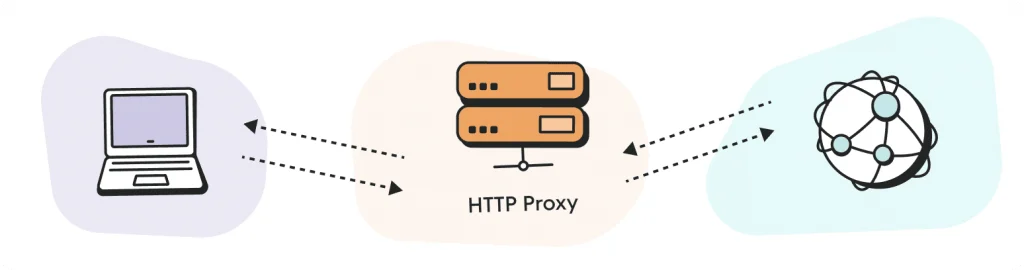
The HTTP(S) Proxy: An Application-Layer Meddler
An HTTP proxy operates at Layer 7 (Application Layer). Its entire existence is predicated on understanding and manipulating the HTTP/HTTPS protocol. It terminates your TCP connection, interprets your HTTP request headers, and acts as a client on your behalf to the destination server. This architectural fact dictates its entire profile.
Its Purview and Fatal Constraints:
- Web Protocol Exclusive: It speaks HTTP or bust. Any non-HTTP traffic (SMTP, FTP, BitTorrent, gaming UDP packets) is an error condition. The proxy cannot encapsulate it; it will reject or corrupt it.
- Header-Aware & Manipulative: It can inject, remove, or modify HTTP headers (
X-Forwarded-For,User-Agent). This is critical for web scraping to mimic browser signatures but is irrelevant for any other protocol. - Content Filtering & Caching Capable: Because it understands the payload, it can block content or cache static resources. This is its sole performance advantage—within its tiny domain.
The Security Illusion: An HTTP proxy provides ZERO transport-layer encryption by itself. Your HTTPS traffic remains encrypted end-to-end, but the proxy sees all connection metadata. It is a logging point. For true traffic obfuscation, it is a liability, not an asset.
The SOCKS5 Proxy: A Session-Layer Conduit
SOCKS5 operates at Layer 5 (Session Layer). It is protocol-agnostic. It does not interpret your traffic; it is a dumb tunnel. Your client instructs the SOCKS5 server: “Establish a connection to target host A on port B.” It does so, then blindly relays bidirectional byte streams. This simplicity is its profound strength.
Its Technical Superiority for General Tunneling:
- Protocol Agnosticism: It transports anything that runs over TCP or UDP. HTTP, SSH, FTP, SMTP, BitTorrent, RDP—it is indifferent. It is the universal network adapter.
- Zero Payload Inspection: It does not parse, modify, or cache your data. This ensures full protocol fidelity and eliminates a layer of potential interference and fingerprinting.
- UDP Support (The Critical Differentiator): This is the line in the sand. Real-time applications (VoIP, gaming, DNS lookups) require UDP. SOCKS5 handles it. HTTP proxies are incapable by design.
- Integrated Authentication: SOCKS5 supports standardized auth methods (e.g., Username/Password), offering a cleaner security model than many HTTP proxy implementations.
The Inherent Limitation: Its “dumb pipe” nature means it provides no application-layer services. No caching. No header manipulation. For pure web tasks, it offers no clever features—only raw transport.
A War Story: The Cost of Protocol Dogma
I recall an infrastructure “optimization” at a previous company. The DevOps lead, in a zeal for uniformity, mandated that all outbound traffic, including internal service-to-service communication and backup data streams, must pass through the company’s high-availability HTTP proxy cluster. The goal was “centralized logging and control.”
The result was a spectacular, slow-motion collapse. The syslog servers, using UDP-based syslog protocol, silently failed. The SSH-based configuration management between data centers began timing out due to the HTTP proxy’s inability to handle persistent, non-web sockets efficiently. The weekly database dump transfer over SFTP would stall, as the proxy buffers choked on the sustained binary stream it couldn’t comprehend.
For two days, the team chased ghosts—checking firewalls, diagnosing network links—until someone ran a tcpdump and saw the graceful HTTP/1.1 400 Bad Request responses from the proxy to a syslog packet. It was absurd. A tool for web traffic was breaking fundamental infrastructure protocols.
The correction was surgical: We deployed a dedicated SOCKS5 proxy (via a hardened dante-server) for all non-HTTP(S) traffic. The HTTP cluster returned to its rightful duty: handling web scraping and browser traffic. Stability was restored. The lesson was brutal: Architectural purity over administrative convenience. Use the right tool for the layer.
Conclusion: The Inescapable Verdict
The debate is not nuanced. It is binary, dictated by the cold logic of the network stack.
- HTTP(S) Proxy: A specialized applicance for the web layer. Its value is in its manipulation of HTTP semantics. Outside of this, it is an impediment.
- SOCKS5 Proxy: A universal transport for the session layer. Its value is in its elegant indifference to your payload. For web-specific tricks, it is inert.
The final judgment is this: Your choice is not between two proxies. It is between competence and negligence. Selecting an HTTP proxy to route UDP game traffic is negligent. Deploying SOCKS5 for a task requiring HTTP header manipulation is incompetent. The protocols are not interchangeable, and attempts to force them to be are a reliable indicator of systemic technical debt.
Stop searching for a “one-size-fits-all” proxy. It does not exist. Design your systems with clarity: define the traffic type, map it to the corresponding layer, and deploy the appropriate gateway. Any other approach is not an engineering shortcut; it is simply broken.