
Recommended Services


Supported Scripts

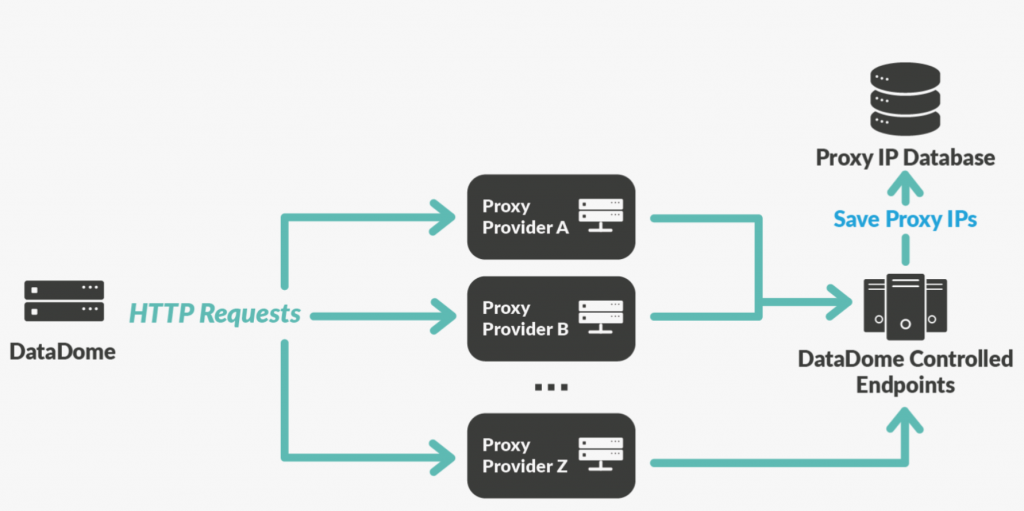
Using datacenter proxies for serious web scraping is not a budget hack; it’s a profound engineering failure. It’s the equivalent of trying to win a Formula 1 race with a golf cart—the fundamental properties are wrong for the task. Your sophisticated parsing logic and machine learning models are rendered useless the moment your request is tagged as server traffic, which happens in milliseconds. This isn’t an opinion; it’s a technical certainty based on how the modern internet identifies and filters traffic.
The Death Knell: ASN Analysis and IP Reputation
The primary and most decisive method for detecting datacenter proxies is Autonomous System Number (ASN) analysis. Every IP address block on the internet is registered to an organization in a public database. When your scraper’s request hits a server, one of the first checks is a simple lookup: does this IP belong to a residential ISP like Comcast or Deutsche Telekom, or to a cloud provider like AWS, Google Cloud, or DigitalOcean?
This is a binary, factual classification. Traffic from a datacenter ASN is instantly categorized as non-human. It receives a high-risk score from reputation services like MaxMind or proprietary threat intelligence feeds. This score is often shared globally; an IP burned by a credit card fraudster one day will be blocked for your price scraper the next. You are not buying an anonymous IP; you are renting a history, and that history is almost always toxic.
Once, in a classic case of over-engineering, we built a complex system to randomize request patterns and rotate user-agents, all routed through a cheap datacenter proxy pool. We thought our logic was flawless. The target site’s defense was more elegant. Instead of serving blocks or CAPTCHAs, which would have alerted us, it began serving our requests from a cached, 48-hour-old version of its product database. For two days, we proudly collected and analyzed completely stale prices, believing our system was working perfectly. We were making critical business decisions based on expired data, convinced we were winning. The fix wasn’t a smarter algorithm; it was abandoning datacenter IPs entirely for residential ones. The moment we switched, the data became real-time—and startlingly different.
The Invisible Fingerprints: TLS, TCP, and Behavioral Mismatches
Assuming you bypass ASN filters (you won’t), layer two of detection activates. This involves analyzing the unique fingerprint of your connection.
TLS Fingerprinting (such as JA3) creates a hash based on the specific way your client announces itself during the SSL handshake—the order of ciphers, extensions, and elliptic curves. A datacenter server’s libraries produce a fingerprint starkly different from a Chrome browser on Windows 11. Advanced security platforms maintain vast databases of these fingerprints, tagging known ones associated with data centers or specific proxy software.
TCP/IP Stack Fingerprinting examines lower-level network characteristics: initial packet Time-To-Live (TTL), TCP window scaling options, and the maximum segment size. These settings are often default and uniform across servers in the same hosting farm, creating a predictable pattern that stands out against the diverse tapestry of residential consumer devices.
Finally, behavioral analysis seals the deal. A session that rotates through IPs in three different countries within a minute, while maintaining the same exact browser language settings and screen resolution, is a physical impossibility for a human. This discordance between the network layer and the application layer data is a glaring, automated red flag.
The Only Viable Architecture: Residential Proxies and Orchestration
The conclusion is non-negotiable. For reliable, large-scale data extraction, you must use a residential or mobile proxy network. These IPs are assigned by actual ISPs to real homes and devices. They pass the ASN test and provide diverse, authentic TLS and TCP fingerprints.
However, simply having residential IPs is not enough. They must be managed by an orchestration layer that does the following:
- Intelligent Rotation: Not random, but based on success rates, target site, and geolocation requirements.
- Session Persistence: Maintaining a consistent IP for multi-step processes (like add-to-cart) to mimic a real user session.
- Header & Cookie Management: Ensuring browser headers, timezone, and language are consistent with the proxy’s geographic location.
- Performance & Health Monitoring: Automatically retiring slow or flagged IPs from the active pool.
This architecture works on a simple economic principle: it raises the cost of defense. Blocking a residential IP risks blocking a paying customer, forcing websites to use more expensive and nuanced behavioral analysis rather than cheap, blanket ASN bans.
Stop Wasting Cycles. Rebuild Your Foundation.
Continuing to build data pipelines on datacenter proxies is an exercise in futility. It wastes server cycles, engineering time, and produces low-quality, unreliable data. The investment must shift from writing cleverer scrapers to deploying the correct network foundation. Your data’s validity is only as strong as the weakest link in its chain of acquisition, and that link is overwhelmingly the proxy layer. Migrate to a managed residential proxy solution with a proper orchestration engine. This isn’t an incremental improvement; it’s the difference between having data and having intelligence.