
Recommended Services


Supported Scripts

Enough with the amateur theatrics. The pervasive notion that “proxy rotation” equates to iterating through a list of IP addresses is not merely incorrect—it is a profound architectural failure that reveals a fundamental misunderstanding of modern web security. You are not outsmarting defense systems; you are providing them with a textbook signature of automation. The contemporary challenge is not IP anonymity; it is behavioral credibility. This credibility is engineered, not randomized. It is the sole domain of a proxy manager—a stateful orchestration layer that imposes logic, context, and strategy upon a pool of otherwise disposable network endpoints.
A proxy manager is not a utility; it is command and control. Absent this layer, your script and your proxy pool exist in a cascading failure loop. You poison IP reputations through detectable patterns, incur financial waste by misallocating premium resources, and operate with zero visibility into failure causality. The manager is the requisite abstraction that translates high-level data acquisition intent into low-level, survivable network transactions.
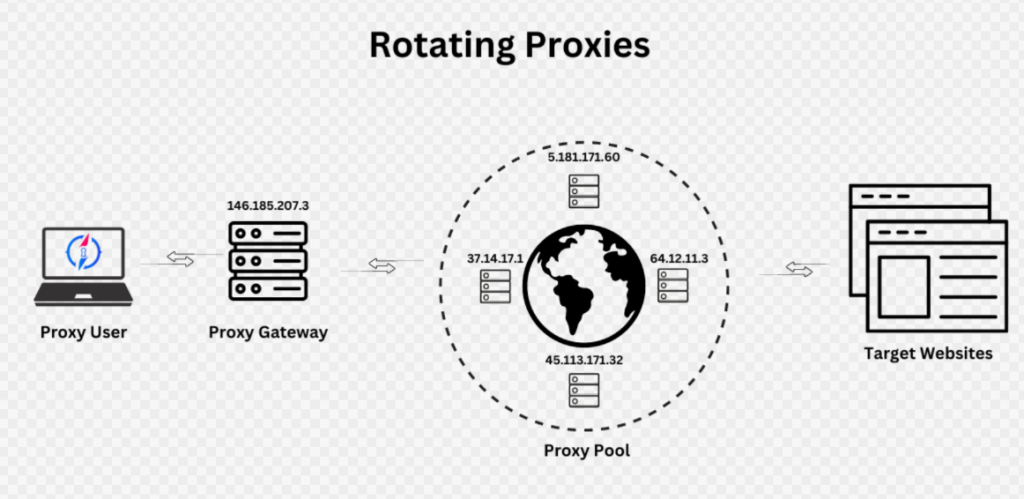
The Inevitable Pathology of Stateless Rotation
The critical failure vector is pattern emission. A stateless script using a pool of 1,000 proxies in a round-robin sequence is not hiding. It is broadcasting. To the target server, the traffic pattern is absurd: sequential requests from geographically disparate IPs (Germany → USA → Japan) exhibiting identical TLS fingerprints, header order, request spacing, and error-handling logic. Sophisticated defenses do not block individual IPs in this scenario; they classify the entire behavioral cluster as malicious and enact countermeasures—serving poisoned data, triggering resource-intensive shadow challenges, or blackholing the session. Your data integrity dissolves silently.
A Cautionary Tale: The Algorithm of Absurdity
Once, in a misguided pursuit of elegance, we architected an in-house “adaptive” rotator. Its logic was pristine: monitor success rates per IP and subnet, dynamically weighting probability to favor performers. The outcome was farcical. We deployed it against a travel aggregator site. The system, in its silicon efficiency, identified that IPs from a minor Icelandic ISP had a 99.8% success rate. Within minutes, it had concentrated 95% of our scraping traffic through Reykjavik. To the target, it appeared as if a sudden, inexplicable tidal wave of booking inquiries had erupted from Iceland—a statistical impossibility that triggered a full regional block and a forensic audit by their security team. Our beautifully logical system had engineered its own demise by failing to comprehend the human context of “plausible distribution.” We rectified it by enforcing hard, randomized geographic distribution rules within the manager—a layer of deliberate inefficiency that restored operational stealth.
A competent proxy manager eradicates this by enforcing session statefulness. It binds a sequence of logically related actions (e.g., a search, product view, and cart addition) to a consistent exit node, maintaining local storage, cookies, and connection lifetimes. It introduces strategic jitter and geographically coherent delays between IP switches from the same provider. It performs real-time response analysis, interpreting not just HTTP status codes but latency gradients, header-based rate-limit signals, and markup alterations indicative of soft blocks. It then executes pre-configured counter-tactics: subnet evacuation, request throttling, or tactical retreat.
Core Manager Functions: From Reactive Switch to Predictive Governor
The manager’s advanced role is predictive health governance. It operates on telemetry, not just errors. A gradual latency increase within a specific autonomous system (AS) is a precursor to a blanket ban. The manager preemptively downgrades all IPs from that AS, quarantining them for low-value tasks or imposing a mandatory cooling-off period. It conducts continuous synthetic monitoring, assessing the baseline “cleanliness” of IPs against known referrers (e.g., search engines, common portals) before admitting them into the high-trust rotation.
This intelligence enables policy-based routing, the manager’s strategic pinnacle. Here, intent meets execution through declarative rules:
TARGET_DOMAIN == "api.valuable-target.com" -> PROXY_TIER = "RESIDENTIAL_US_NORTHEAST"; SESSION_LOCK = TRUEREQUEST_PATH contains "/static/" -> PROXY_TIER = "DATACENTER_BANDWIDTH"; RETRY_LOGIC = NONERESPONSE_CODE == 429 -> CURRENT_SUBNET_BAN = 900s; RETRY_VIA = "ALTERNATE_CARRIER"
This is not rotation. It is precision resource orchestration. High-fidelity residential IPs are allocated to transactional endpoints. Low-cost datacenter bandwidth soaks up static asset overhead. The manager becomes a policy engine, ensuring cost and reputation are aligned with task criticality.
The Resolution
The Icelandic fiasco’s solution was not a more complex algorithm, but a more context-aware one. We integrated a geolocation and ISP reputation database directly into the manager’s decision core. The rule became: “No more than 5% of daily traffic per country, and no more than 15% per major ISP, irrespective of immediate success rate.” We added synthetic user flow simulations to warm IPs before critical jobs. The result was a 70% drop in target-triggered security events and a 40% increase in data consistency. The manager enforced the strategic chaos necessary to mimic organic traffic, turning our pool from a liability into a reliable instrument.
Deploying proxies without a manager is an exercise in operational masochism. It is the equivalent of launching a satellite with no flight computer, hoping ballistics alone will achieve orbit. The proxy manager is the guidance system. It provides the deterministic control required to navigate the adversarial environment of the modern web. In the hierarchy of data extraction necessities, the manager is not tier two; it is foundational. The alternative is not merely inefficiency—it is guaranteed, predictable, and expensive failure.