
Recommended Services


Supported Scripts

Let’s be brutally clear. The “debate” between mobile and datacenter proxies isn’t a debate. It’s a confrontation between engineering and ignorance. Datacenter IPs are technological refuse for any task requiring a semblance of legitimacy. Their reputation is zero. They are the burned-out, screaming neon sign announcing “BOT NETWORK” to every anti-fraud system from Palo Alto to Cloudflare. If you’re using them for anything other than impersonal, bulk data fetches or stress-testing your own servers, you are fundamentally misunderstanding how the internet’s immune system works. This isn’t opinion; it’s packet-level reality.
The Anatomy of Failure: How Anti-Fraud Systems Dissect Your Traffic
Your IP address is not an anonymous number. It’s a detailed dossier. Anti-fraud engines maintain real-time databases mapping IP ranges to their originating autonomous system number (ASN). The ASN for Amazon Web Services (AS16509) or DigitalOcean (AS14061) is public record. A datacenter proxy’s traffic originates from these ASNs. The connection is instantly flagged as non-residential. The system then analyzes headers, TCP fingerprint, and TLS handshake for inconsistencies typical of proxy software. The verdict is automated, instantaneous, and merciless: BLOCK.
Residential proxies attempt to solve this by using IPs from consumer ISP ASNs (e.g., Comcast Cable). This is a layer better. However, the infrastructure is often ethically and technically flawed. Many providers utilize peer-to-peer networks or SDKs embedded in free apps, creating a pool of unstable, low-bandwidth endpoints with inconsistent uptime. Furthermore, these IPs can be recycled and may arrive with a pre-existing history of abuse. You’re not buying a clean slate; you’re renting a stranger’s potentially problematic online history.
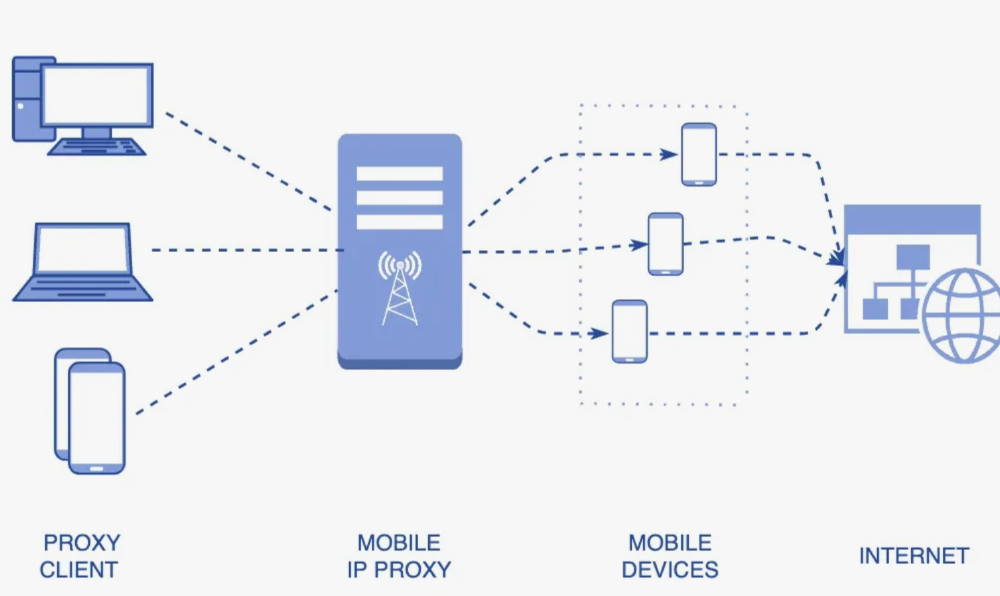
The Engineering Superiority of Mobile Networks (4G/5G)
Mobile proxies operate on an entirely different architectural plane. Traffic is routed through physical modem banks utilizing real carrier SIM cards (MNOs like T-Mobile, Vodafone). The IP assigned is dynamically pulled from the carrier’s massive, constantly rotating pool dedicated to mobile devices. The ASN belongs to the carrier. The TCP fingerprint matches a modem or smartphone. The geolocation is precise and aligns with cell tower data.
This is not masking; this is becoming a legitimate mobile user at the network level. The cost is higher because you are paying for physical hardware, SIM cards, and carrier-grade infrastructure—not just virtual servers. To complain about the price is to complain that a forged passport costs less than a real one. One is a cheap prop; the other grants actual passage.
A Lesson from Our Own Stupidity: The Great Price-Scraping Fiasco
Once, in a dire attempt to cut costs on a major e-commerce price monitoring project, our team decided to “get clever.” We reasoned that since we were only scraping public prices, we didn’t need “fancy” mobile IPs. We deployed a massive pool of cheap datacenter proxies. For 48 hours, it was glorious. The speed was phenomenal; the data flooded in. Then, on the third day, complete silence. Every single IP range we used had been null-routed by the target’s firewall. The entire dataset was corrupted with missing blocks, and our infrastructure was permanently flagged. We had to scrap the project, rewrite the scraper, and start over with mobile proxies. The “money we saved” was a negative number, factoring in lost time, wasted compute resources, and developer frustration. The fix was infuriatingly simple: we switched to a targeted, low-request-volume strategy using mobile IPs. The scrapers have run silently and flawlessly for 18 months now. The moral? Engineering shortcuts around fundamental trust mechanics always fail. Always.
The Uncompromising Decision Matrix
Stop thinking in terms of “proxies.” Think in terms of Trust Tiering.
Tier 1 (Mobile / 4G-5G): Maximum Trust.
- Use Case: Account management (Social, Advertising, E-commerce), Advanced web scraping (anti-bot protected sites), Ad verification, Mobile app testing.
- Technical Rationale: ASN and IP reputation are identical to end-user mobile devices. Virtually immune to blocklists targeting datacenter/residential ranges.
- Provider Mandate: Must supply “raw” carrier connections, not VPN-tunneled residuals. Transparency on carrier and pool rotation is non-negotiable.
Tier 2 (Residential / ISP): Conditional Trust.
- Use Case: General web scraping (low to medium protection), SEO monitoring, Long-term single-IP tasks, Basic geo-access.
- Technical Rationale: Correct ASN is its primary advantage. Quality is a massive spectrum; you must vet the provider’s sourcing (partnered ISP vs. P2P network).
- Warning: Speed and success rates are inconsistent. These are a tool for specific, tolerated automation, not for impersonation.
Tier 3 (Datacenter): Zero Trust.
- Use Case: Data mining unprotected public APIs, Load/penetration testing, Rapid IP rotation for non-sensitive tasks.
- Technical Rationale: Useful only for raw throughput and anonymity from the end target, not from the network. Its defining characteristic is its universally poor reputation.
- The Hard Truth: If your project fails using only datacenter IPs, the problem is not the proxies. The problem is that your project’s requirements fundamentally necessitate a higher trust tier. No amount of tweaking will fix a foundational mismatch.
Conclusion: Pay the Iron Price for Access
The digital landscape is a war of attrition between automation and security. Security layers are built on the axiom that datacenter IPs are hostile. Using them against modern platforms is not a strategy; it is a confession of technical incompetence.
Invest in the infrastructure that matches your operational security requirements. For Tier 1 tasks, this means mobile proxies. The initial expenditure is not a cost; it is a capability purchase. It is the difference between building on granite and building on sand. The granite invoice may be higher, but you only pay it once. The sand invoices you forever, with every collapsing wall. Choose granite.