
Recommended Services


Supported Scripts

Let’s dispense with the analogies. A computer network is a system of interconnected nodes architected for data exchange and resource sharing. Its efficacy is not a matter of opinion; it is a function of adherence to foundational principles—principles that are, with baffling regularity, ignored. This results in predictable, costly failures. What follows is a technical analysis of core network classifications and topologies, intended for professionals who prefer precision over platitudes.
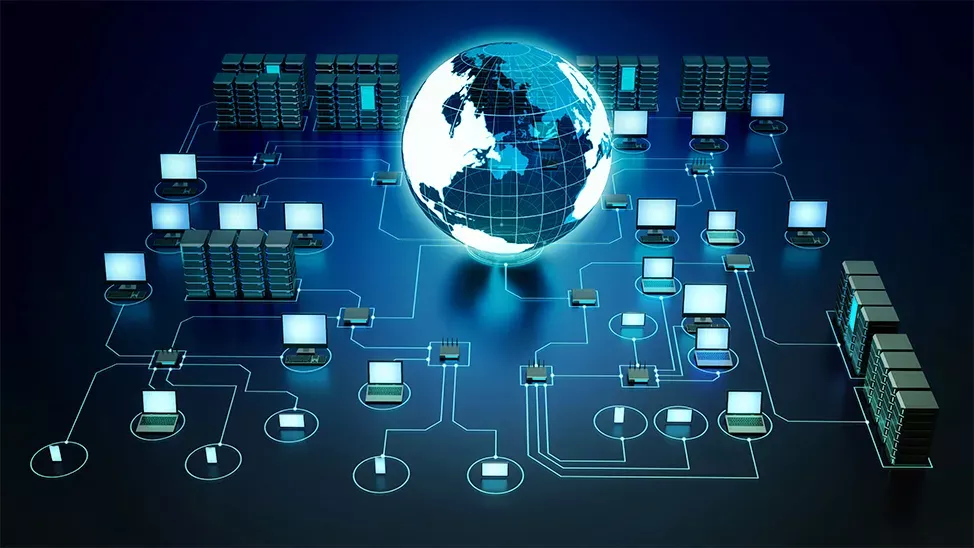
Network Typology: Scale Defines Purpose
The conflation of network types is a primary source of systemic inefficiency. The taxonomy is rigid and exists for reason.
- Local Area Network (LAN): A high-bandwidth, low-latency network constrained to a limited geographical area, typically a single building or campus. Its purpose is the efficient sharing of local resources: file servers, networked storage (NAS/SAN), and peripherals. The standard for physical layer connectivity is IEEE 802.3 (Ethernet) over twisted-pair copper (Cat 5e/6/6a) or fiber optics. Wireless LANs (IEEE 802.11) are a complementary access layer technology, not a replacement for wired infrastructure for stationary, performance-sensitive nodes.
- Metropolitan Area Network (MAN): An infrastructure spanning a city or large campus, often employing dark fiber or carrier Ethernet services (e.g., Metro-E) to interconnect disparate LANs. It is not a “big LAN.” It is a high-capacity aggregation layer.
- Wide Area Network (WAN): A network connecting geographically separate LANs/MANs over long distances. It utilizes leased lines (MPLS), broadband (DSL, Cable), or cellular (LTE, 5G) links. The Internet is a global public WAN. Performance is dominated by latency and bandwidth constraints of the provider’s infrastructure, making local resource caching and traffic shaping critical.
A Cautionary Tale of Scale: I once consulted for a firm that decided its 500-employee headquarters and a remote 5-person sales office constituted a single “big LAN.” They attempted to run a real-time database application across a consumer-grade VPN tunnel on a broadband connection. The result was, predictably, transactional latency measured in seconds, rendering the software unusable for the remote team. The fix was elementary: reclassifying the link as a WAN, implementing a local cache server at the remote site, and syncing data asynchronously. Throughput increased by 4000%, and user complaints ceased. The lesson: Misapplying network typology is not an architectural choice; it is an error with measurable financial impact.
Physical Topology: The Inescapable Logic of the Star
Topology defines the physical and logical arrangement of nodes and links. Three archetypes exist, but only one is suitable for modern, maintainable network design.
- Bus Topology: An obsolete architecture where all nodes share a single collision domain on a common backbone cable (e.g., 10BASE2, 10BASE5). A single cable fault or termination failure collapses the entire segment. Its use in any new deployment after approximately 1995 is indefensible. It survives only in legacy industrial control systems and the nightmares of veteran administrators.
- Ring Topology: Nodes are connected in a closed loop, with data traveling unidirectionally (e.g., Token Ring, FDDI). While deterministic and avoiding collisions, a single link or node failure breaks the ring. Dual-ring implementations (like FDDI) provide fault tolerance at added complexity and cost. Its niche is in high-availability transport networks (SONET/SDH), not in data link layer access networks.
- Star Topology: Every end-node connects via a dedicated link to a central switching device. This is the universal standard for LANs for unambiguous reasons:
- Fault Isolation: A link failure affects only one node.
- Scalability: Adding a node requires a single port on the central switch and one new cable run.
- Performance: Each node has dedicated bandwidth to the switch, and modern switches provide non-blocking, full-duplex operation.
- Manageability: Centralized monitoring and traffic management are inherent.
The central device—a Layer 2 switch—is a single point of failure only for the naive. Enterprise designs employ switch stacks, redundant power supplies, and uplinks to a resilient core. To architect a new data network around a bus or ring topology is professional negligence.
Transmission Media: Selecting the Correct Tool
The medium is a critical, physical constraint. Misselection artificially caps performance and reliability.
- Twisted-Pair Copper (Cat 5e and above): The baseline for end-node connectivity. Cat 6a supports 10GBASE-T up to 100m. It is cost-effective, easy to terminate, and sufficient for >99% of desktop and phone connections.
- Fiber Optic (Multimode/Single-Mode): Used for high-bandwidth uplinks, backbone connections, and any run where distance (>100m), EMI resistance, or electrical isolation is required. Single-mode fiber is mandatory for inter-building or long-distance WAN/MAN links.
- Coaxial Cable: In networking contexts, it is a relic. Its continued use is typically a symptom of institutional inertia or a specific RF application (e.g., cable modem termination).
An Anecdote on Absurdity: A client once proudly declared they had “future-proofed” their new office by installing only Category 5e cable, believing software could later “unlock” higher speeds. This is a fundamental misunderstanding of the physical layer. You cannot negotiate a 10 Gbps link on a cable rated for 1 Gbps. The subsequent “fix” involved a costly, disruptive re-cabling project to Cat 6a within 18 months of occupancy, when they deployed high-resolution video editing workstations that saturated the 1 Gbps links. The correct approach is to install cabling that meets or exceeds the anticipated lifecycle bandwidth requirements of the space. Cabling is a 10-15 year investment; economizing here is the pinnacle of false economy.
Conclusion: Precision Over Persuasion
Network design is not a creative art. It is a discipline of applied engineering. The specifications for LAN, MAN, and WAN are defined. The superiority of the star topology is proven. The characteristics of transmission media are published in IEEE standards. Failure manifests not as a difference of opinion, but as packet loss, latency, downtime, and financial waste. Deploy solutions that adhere to established technical rigor, or prepare to manage the entirely predictable consequences.